












The economics of warehousing are shifting. Rising real estate costs, the need for greater SKU variety, and the push toward faster fulfillment are driving facilities to adopt higher-density storage configurations. Narrow aisles — often 6 to 8 feet wide — maximize cubic utilization but introduce new operational challenges, particularly for automation.
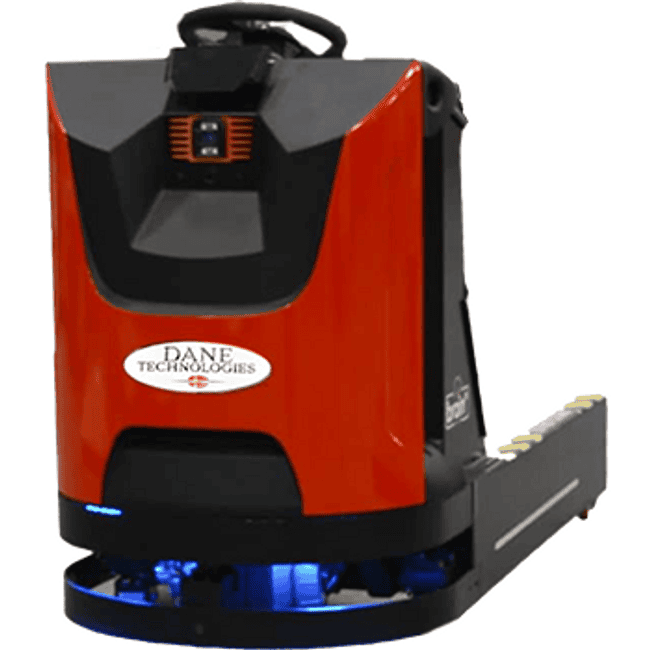
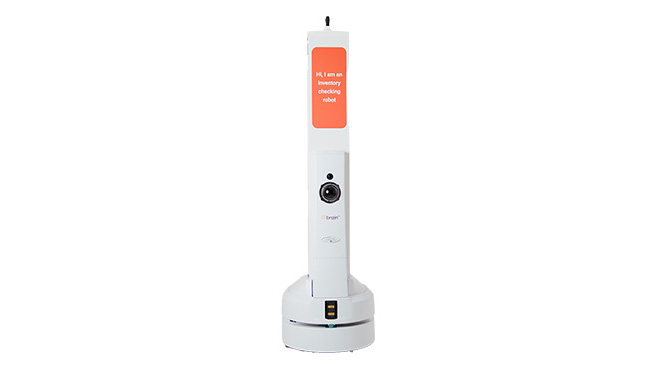
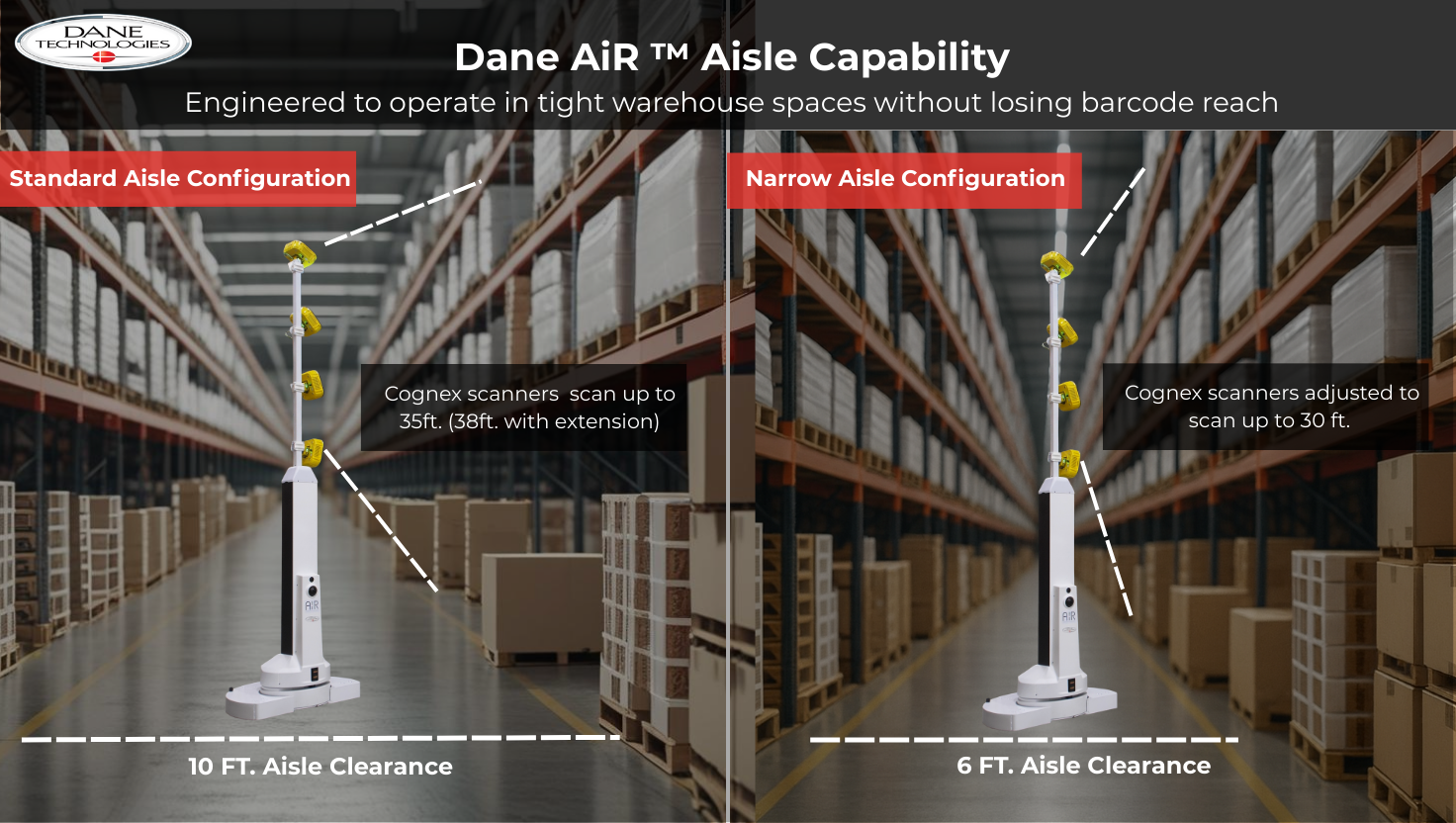
Historically, many autonomous inventory scanning solutions have required wide aisles to function effectively. This has limited their viability in high-density environments or forced costly reconfiguration projects. Conversely, the Dane AiR™ shows that automation can now operate within these constraints without sacrificing reach or data quality.
The Operational Challenge
Space optimization vs. accessibility – Narrow aisles increase storage capacity but reduce maneuvering room for equipment.
Barcode reach – In tall racking environments, reduced lateral clearance can compromise a scanner’s ability to capture barcodes at the upper levels.
Infrastructure impact – Retrofitting facilities to accommodate automation can be costly and often means losing storage positions — eroding the very efficiency gains high-density layouts were meant to deliver.
Adapting to Space-Constrained Environments
The Dane AiR™ is engineered to operate across a range of warehouse configurations, including aisles as narrow as 6 feet. Adjustable scanning profiles maintain vertical reach — up to 35 feet in standard settings, 38 feet with an extension configuration, and 30 feet in narrow aisle configuration— without compromising accuracy or coverage. This means the Dane AiR™ can ensure consistent data capture in mixed layouts, cold storage zones, or other space-limited conditions.
Strategic Implications for Operations Leaders
Preserves storage capacity
Avoids the need to widen aisles or remove racking.
Accelerates deployment
Minimizes infrastructure changes, reducing downtime and cost.
Adapts to mixed layouts
Delivers consistent data capture regardless for most storage configurations.
Looking Ahead
As warehouse footprints become more expensive and throughput expectations rise, automation’s value will increasingly be measured by how well it fits into existing infrastructure. Solutions that require minimal adaptation — while still delivering high-quality, high-speed data — will be the ones that scale across diverse networks.
Narrow aisle capability is not just a technical feature; it is a direct response to the structural trends shaping modern supply chains. For leaders planning the next phase of warehouse automation, narrow aisle capability must be a central consideration in automation solutions.
